|
On Time Quote Trend |

Overview
The On Time Quote Trend report focuses on the percentage of Coverage Groups that were quoted on time to the original Due Date. Out of those, it calculates the percentage of Coverages that were on time to the original Due Date and at least once in the Follow-up on Missing Information Activity. It also shows the total number of quoted Coverage Groups.
This information is available by market segment, region, Group Office and Rep, for a rolling 12 month period.
Table of Contents
This report has summary pages.
- To display a comparison of regions for this market segment, click on a market segment node on the Table of Contents.
- To display a comparison of Group Offices, click on a region.
- To show a comparison of Reps for the Group Office, click on the Group Office.
Report Detail
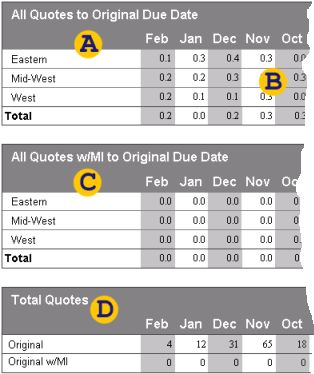
This sample report is a market segment summary. It compares regions. The first section shows percentages of quotes on time to the original Due Date out of all quotes for this market segment.
The percentages in the total row are calculated from the total number of quotes and the total number of quotes on time. This can be misleading, because this number is usually not the average of the detail percentages. (However, the reports shown in the above example are definitely incorrect -- this bug has been fixed already). Let's look at an example:
Total On Time Percentage Eastern 10 1 0.1 Mid West 10 10 1.0 West 10 0 0.0 Total 30 11 0.3 (!)
Percentages are displayed with one decimal precision. For this report, a Coverage Group was on time if the End Date of the latest Underwriting or Re-underwriting Activity is before the Coverage Group Due Date (the Due Date for all Coverages in a Coverage Group must be the same).
The second section shows percentages of quotes on time to the original Due Date out of all quotes that were in the Follow-up on Missing Information Activity at any time.
The last section shows the actual number of Coverage Groups that were quoted on time for this market segment, and out of those, the number of Coverage Groups that were missing information.